You see it from the couch every single time. The manager leaves a striker on for twenty minutes too long. The pressing shape dissolves and nobody shifts to a back five. The substitution comes six minutes after it was obviously needed. You knew. You always know. The question is whether you actually do.
That gap between watching and deciding is exactly what a football tactics board is built to close.
What a Football Tactics Board Actually Does
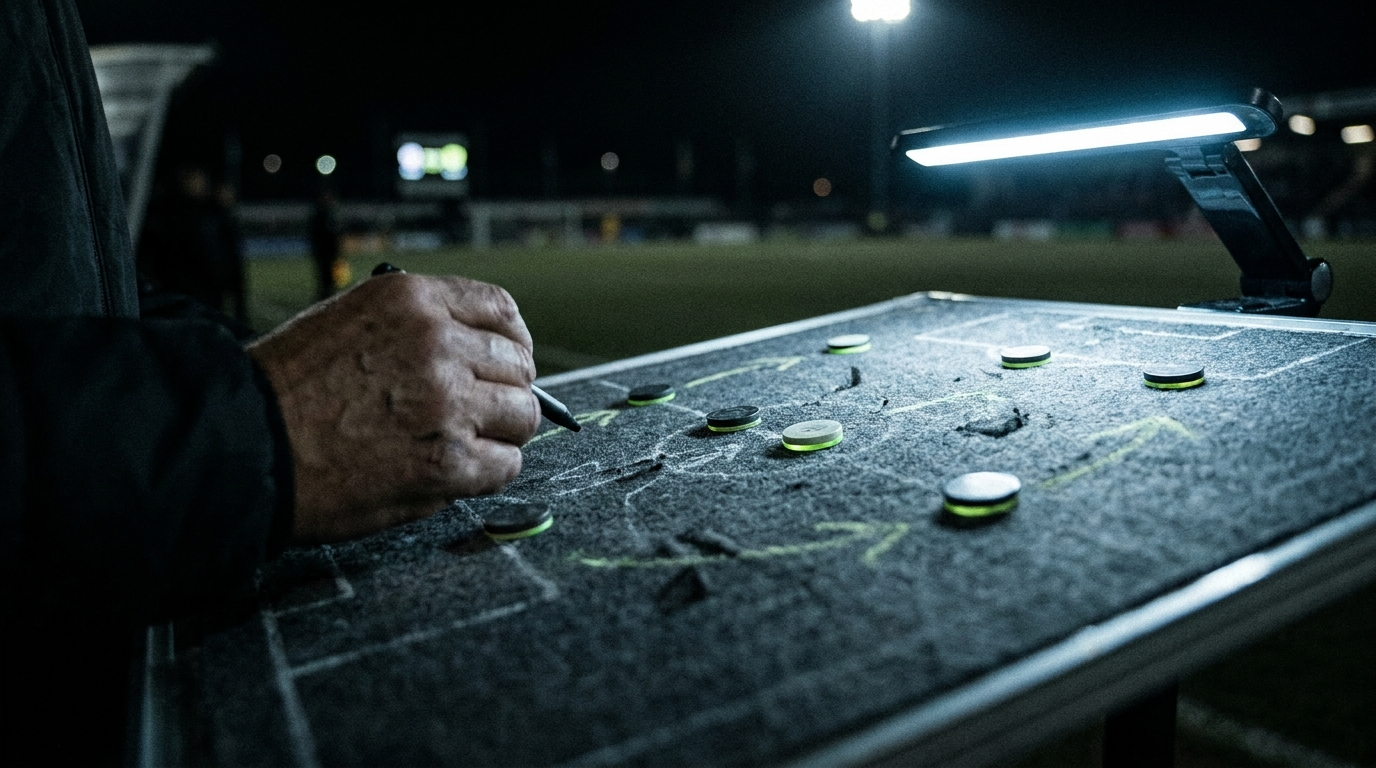
A tactics board is a planning tool that lets you arrange players, map movement, and test formations before a ball is kicked. Coaches use physical magnetic boards on touchlines. Analysts use software to diagram pressing triggers and defensive blocks. And increasingly, football fans use online versions to think through the same problems.
The best online tactics boards let you:
- Drop players into a formation and see how the shape holds across phases of play
- Adjust roles and positioning to test width, compactness, or high-line defending
- Model substitutions and see how a lineup change shifts the team's balance
- Compare your decisions against what actually happened in a match
That last point is where things get genuinely interesting. A static board is useful for learning. A live board, one that puts your decisions against real match outcomes, is where tactical thinking becomes a real test.
Why Formation Choice Is More Complicated Than It Looks
Most fans default to picking a formation they recognize: a 4-3-3 because their favorite team plays it, or a 4-4-2 because it feels balanced. But formations are not just shapes. They are a set of relationships between players, and those relationships change depending on who you have available.
A 4-3-3 with a deep-lying playmaker sitting behind two dynamic eights looks completely different from a 4-3-3 built around three forwards who press relentlessly from the front. Same numbers, totally different game.
Some of the key decisions a tactics board forces you to make:
Width and depth. Do your fullbacks push forward and create overloads wide, or hold a disciplined line? If they push up, who covers the space behind them?
Pressing height. Where does your team start pressing? A high press forces errors but demands enormous fitness and coordination. Drop too deep and you concede territory without recovering the ball.
Pivot roles. A single pivot sitting in front of the defense protects a back four and allows the two midfielders ahead to take risks. Remove that player, and suddenly the center-backs are exposed every time possession turns over.
Transition shape. Most goals in modern football come from transitions, the moments between losing the ball and reorganizing defensively. How quickly can your shape recover? A tactics board that makes you think about this is one that makes you a sharper viewer.
The Substitution Problem (and Why Fans Underestimate It)
Tactical planning before kickoff is one thing. Managing a live match is something else entirely.
Substitutions are one of the most scrutinized decisions in football. Managers get torn apart for bringing on the wrong player, or for waiting too long, or for burning all three changes before the game opens up. Fans are especially vocal about this because substitutions feel visible and decisive in a way that other tactical choices do not.
But making substitutions well under pressure is genuinely hard. You are reading a game in real time, accounting for fitness levels you cannot fully see, trying to change momentum without disrupting what is working, and managing the psychology of players coming on and coming off.
The players you do not bring on matter as much as the ones you do. Keeping a creative midfielder fresh for the final twenty minutes can be the difference between holding a result and winning it. The bench is part of the tactic.
Any online tactics board worth using makes you think about substitution timing, not just formation shape.
Using a Tactics Board to Read Matches Better
One of the most practical uses of an online tactics board is preparation: studying a formation before you watch a match so you understand what you are looking at.
If you know a team lines up in a 3-4-2-1 with wing-backs who push very high, you can immediately see the risk when the opposition plays direct balls behind them. If you have mapped out how a team's central midfield is set up to press, you will notice the moment that press breaks down and why.
Tactical awareness is a skill that compounds. The more formations you diagram, the more quickly you spot structural problems in real matches. The more you think through substitution scenarios, the more clearly you understand why a manager made the choice they did - or why it was clearly wrong.
A tactics board does not just help you coach. It helps you watch.
Where Live Decision-Making Changes Everything
There is a ceiling to what a static tactics board can teach you. At some point, the real test is not planning a lineup but making decisions as a match unfolds in front of you.
This is what separates armchair analysis from actual understanding. You might be convinced you would have brought on a second striker at 0-0 in the 65th minute. But would you have done it if your team had been under pressure for fifteen minutes and the defensive shape was already fragile? Would you have held the line, or would you have chased the game?
That live pressure, the uncertainty about whether your call is right, is where tactical knowledge either holds up or falls apart.
GAFFER is built around exactly this idea. It is a live football coaching game where you make real tactical decisions during actual matches - picking your formation, managing your lineup, calling your substitutions - and then your choices are measured against the real manager's decisions and outcomes. It is free to play, and it is the closest most fans will ever get to finding out whether their tactical instincts are actually sound.
Getting Started With Online Tactics
If you want to develop your tactical thinking, here is a straightforward approach:
- Pick one formation and study it properly. Understand the relationships between positions, not just the shape.
- Watch matches with a specific question in mind. Instead of watching generally, focus on one thing: how does this team defend transitions?
- Use a tactics board before and after matches. Plan what you expect, then diagram what actually happened.
- Make live decisions and compare them. This is the step most fans skip, and it is the most valuable one.
The gap between knowing tactics and applying them under pressure is real. The only way to close it is to put your decisions on the line against actual match situations.
You have been coaching from the couch long enough. Find out if you are right.
Try it on GAFFER -> gaffer.house
Ready to test your coaching instincts?